Multi-functional switches of ditopic ligands with azobenzene central bridges at a molecular scale

Our article is available to read at Nanoscale
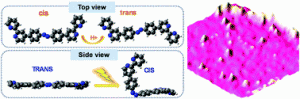
Ligands are designed to have ditopic bipyridine terminal groups linked through photochromic azobenzene central units, which exhibit multi-switchable properties by different external stimuli. The molecule can switch between cis-and trans-conformations at their bipyridine terminal groups upon protonation and at their central azobenzene units upon irradiation of photons. As a result, the system shows four different isomeric states: cis–TRANS, trans–TRANS, cis–CIS and trans–CIS. The four conformers are switched and are visualized by scanning tunneling microscopy at the solid–liquid interface, which gives a direct demonstration of the multi-functional switches at a molecular level.

 

Photo/Redox-Responsive 2D-Supramolecular Assembly Involving Cucurbit[8]uril and a Star-Shaped Porphyrin Tecton

Our article is available to read at Electrochim. Acta

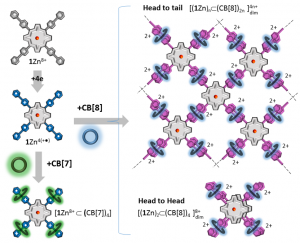
The present paper reports on the formation and on the electrochemical/spectroscopic characterization of inclusion complexes formed in aqueous media between cucurbit[7 or 8]urils cavitands (CB[7], CB[8]) and a rigid four-pointed star-shaped viologen-appended porphyrin tecton. The formation of discrete 4:1 pseudo-rotaxane-like caviplexes, involving threading of CB[n] rings on the rigid viologen-based star’s branches has been demonstrated by nuclear magnetic resonance and mass spectrometry measurements. Then, the photo- and redox-triggered formation of 2D supramolecular assemblies involving CB[8]s and the four electron reduced tectons as key building elements, has been established on the ground of in-depth electrochemical and spectroscopic analyses supported by quantum calculations. The CB[8]-promoted intermolecular π-dimerization of the viologen cation radicals introduced at the meso positions of the porphyrin plateform has been brought to light through the diagnostic signatures of the 1:2 host-guest ternary caviplexes formed between viologen and CB[8] and by spectroscopic data collected after electrochemical, chemical or photochemical reduction of the viologen-based tectons. The CB[8] hosts not only proved useful to promote the redox-triggered formation of supramolecular assemblies, it was also found to prevent the chemical reduction of the porphyrin ring in aqueous media and its subsequent conversion into phlorin products.

Denis Frath obtained his PhD in chemistry from the University of Strasbourg in 2013 (laboratory of Dr. Gilles Ulrich and Raymond Ziessel). His doctoral work, supported by a MENRT scholarship, focused on hydrogen production using light and the synthesis of new fluorescent dyes. He then joined the Matsuda laboratory to work on photoresponsive self-assembled monolayers as a JSPS postdoctoral fellow at Kyoto University (2013-2015). After that, he worked on redox-active molecular layers for electronic devices at Paris Diderot University (2016-2017) and binuclear phthalocyanine metallic complexes for catalytic reactions at CNRS in Lyon (2018).

Since 2018, he is CNRS researcher at the Chemistry Laboratory of ENS Lyon where he is head of the Supramolecular Chemistry and Chemical Biology group. His research interests are directed towards π‐conjugated molecules with optical and electrochemical properties, their supramolecular self-assembly and functional materials with switchable properties (gels, liquid crystals, surfaces…). In 2024, he was awarded the SP2P Young Researcher Prize (French Chemical Society).