Thanks to the hard work of Sumit Bawari and the collaboration within ANR Hykalin, we have identified the barrier of water dissociation as a critical, cation-dependent step during the alkaline hydrogen evolution reaction. This is one of the first applications of our electrostatic embedding QM/MM exploiting VASP and CP2K, as developed during the ANR TERS_NORMAL through the thesis of Mingjun Gu. Check out our publication in ACS Electrochemistry. My first publication in this journal!
Category: Publications
PtO2 is found in ferromangenese nodules
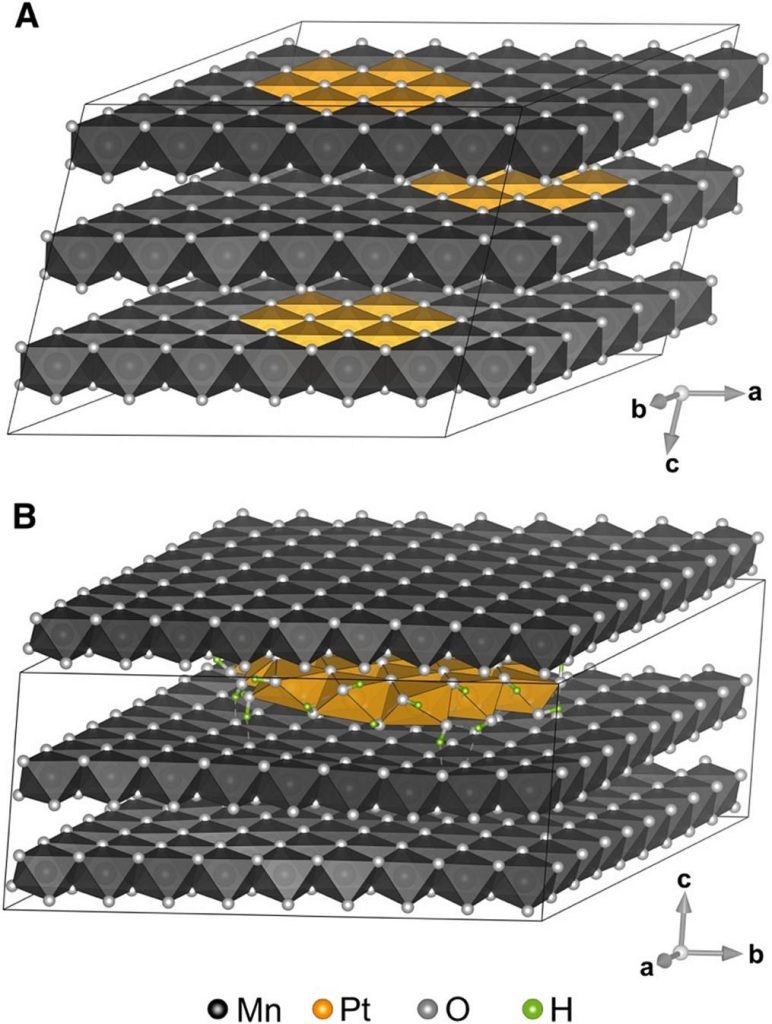
In the framework of the ERC DEEP-SEE of Alain Manceau, we have revealed the form and nanometric arrangement of Pt in
ferromanganese nodules. Structural model B (intercalated nanoflakes) matches very well with the experimental signatures. If you are interested in the full story, check out our publication.
Mechanism of Ce oxidation on MnO2 containing marine sediments
Coming back from holidays and announcing a newly published article is always a pleasure. A big thank you to Alain Manceau and the whole ERC DEEP-SEE team for this beautiful work on the oxidation of Ce on MnO2 in sea-floor sediments, now available on Environ. Sci. Technol.
Near infrared polychromism
In collaboration with Tangui Le Bahers and thanks to the hard work of Raphaël Rullan, I’m very glad to announce that our joint computational and experimental work on the photochromism of Davyne is now available in Angewandte Chemie.
Furfural electro-reduction on Cu
After quite some work, I am very pleased to highlight our recent collaboration with IRCELyon (M. Prévot and his excellent PhD student, C. Spadetto) on understanding the electro-reduction of furfural on copper, now published in J. Am. Chem. Soc. Our contribution was mostly dedicated to the interpretation of the experimental Raman spectra: Identifying the origin of the observed peaks that correlate with the selectivity towards methylfurane and furfuryl alcohol has been a challenge only possible due to Raman intensities of relevant intermediates. The mechanistic insights turned out to be of minor importance, given that the competition between hydrogen atom transfers and proton coupled electron transfers remains an extraordinary challenge to describe at the atomistic level.
CO2 electroreduction over MoS2
After an immense effort, the post-doctoral work of Akif has finally been published: ACS Catalysis just published our extensive investigation of C-C coupling and C-O bond breaking under electrochemical conditions on the edge of MoS2.
Room temperature phosphoresence as viewed from a materials perspective
Our collaborative work on understanding room temperature phosphoresence in purely organic crystals is now online in Journal of Materials Chemistry C. Raphael has worked hard to make it happen and I’m particularly happy that BLW/ALMO has, once again, proved useful to understand chemistry!
HMF electro-oxidation on NiOOH
Tony Ermacora has worked hard in the context of the EIC project ELOBIO: His manuscript on the classical Fleischmann (indirect) mechanism of HMF oxidation if now available in Electrochimica Acta. It is a challenging system and identifying these transition states was a real challenge!
Ce in MnO2 from nodules in the ocean
Where is Gadolinium in sea-floor sediments?
As part of the ERC project DEEP-SEE (collaboration with Alain Manceau), the next chapter of the incorporation of rare earth elements in apatites from the sea floor is now published in Environmental Science: Nano. It turns out that Gadolinium is not associated with cerium in a phosphate rich precipitate, but rather present in the amorphous layer surrounding apatite, similar to yttrium. Indeed, computations evidence that a medium-range distance (about 6.2 Å; just out of reach for EXAFS detection) between Gd and/or Y atoms leads to the most stable aggregate.
the accumulation of cerium in manganese oxides from the sea-floor as revealed by EXAFS and DFT.