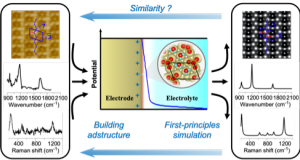
I feel very privileged to have been part of this beautiful, fundamental study about the organization of the electrode/electrolyte interface. The Xiamen group has done excellent work!

I feel very privileged to have been part of this beautiful, fundamental study about the organization of the electrode/electrolyte interface. The Xiamen group has done excellent work!

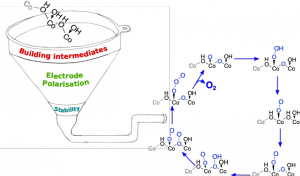
The hard work of Antton Curutchet and Tangui Le Bahers has paid out. The grand-canonical DFT study of the oxygen evolution reaction (OER) in alkaline solution over the CoOOH model catalyst has finally been published.

It is a great pleasure to announce my first publication with geologists. I am very grateful to them for the exciting work in which I had the chance to participate.
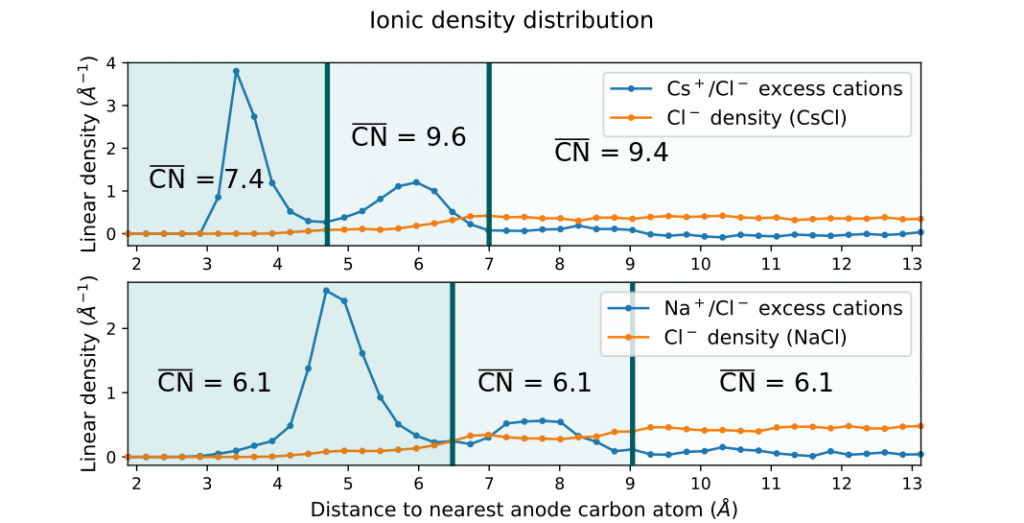
After a lot of hard work, the second article of Ruben has been published in the Journal of Chemical Physics. The scheme, called ASANN, provides robust coordination numbers for solid-liquid interfaces and metal (alloy) nano-particles and surfaces.
The picture below reports the cation distribution and coordination at a graphite electrode of about -2.5 V vs. SHE. ASANN resolves that Cs+ is partially desolvated at the interface, while Na+ is not.

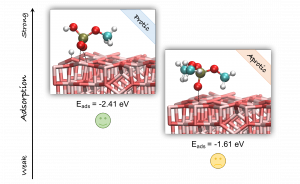
Sarah’s first article, entitled “Adhesion of lubricant on aluminium through adsorption of additive head-groups on γ-alumina: A DFT study” is now online. Congratulations!

Our article on the implementation and the use of the linearized Poisson-Boltzmann Equation in VASPsol has finally been published online.
I am very greatful to all my co-authors and in particular to Richard Hennig for the co-authorship at a late stage of the manuscript.
After significant investments in terms of computations and time, our article on the estimation of free energies of adsorption on metal surfaces is finally online!

We all have worked hard to make it happen and I am very grateful to my co-authors for this!

Our joint theory-experiment work on EPOC is now online in Catalysis, Science & Technology.
The 70th annual ISE meeting in Durban (South Africa) has been a great conference.
Even though my invited presentation does not contain a lot of electrochemistry, the presented methods and challenges have spurred some discussion.
Our collaborative work on the pressure gap of methane thiol adsorption on Au(111) is online. The high-pressure (1 bar), high temperature (~400 K) STM work and its simulations have been a real challenge, but the joint interpretations have allowed to identify a phase transition upon increasing the pressure compared to the commonly observed low pressure structures.