Work as a function of protocol duration for the efficient erasure of an underdamped memory: isothermal to adiabatic transition

Nicolas Barros, Stephen Whitelam, Sergio Ciliberto, Ludovic Bellon, submitted to J. Stat. Mech.

arXiv: 2609.11473

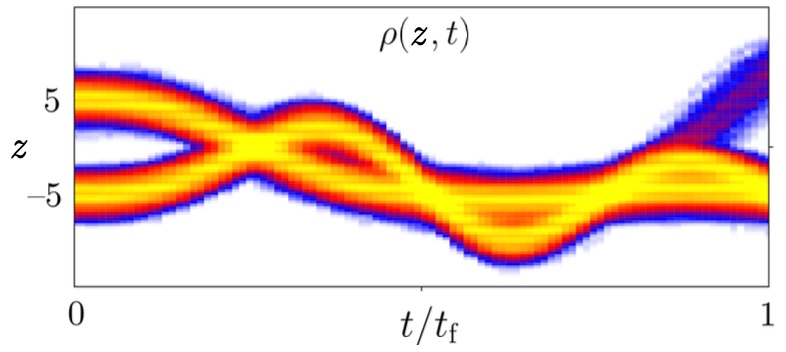
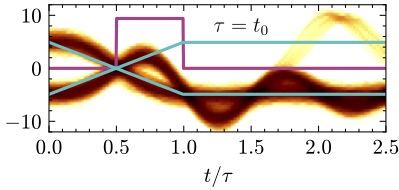
We use evolutionary reinforcement learning to determine efficient time-dependent erasure protocols for an underdamped cantilever moving in a double-well potential, an experimental realization of a 1-bit memory. We investigate how the mean work ⟨W⟩ needed to erase a bit scales as a function of the protocol duration τ. We find two regimes, depending on how τ compares to the relaxation time of the system tr. For τtr, the quasistatic isothermal regime, we recover Landauer’s bound plus an overhead that scales as 1/τ, similar to the overdamped case. By contrast, for τ<tr erasure becomes adiabatic and ⟨W⟩ grows more slowly than in the isothermal case. This growth is bounded from below as 1/τ, which we derive using a gedanken optimal protocol. Finally, comparison with overdamped erasure shows that learned protocols can outperform protocols that are optimal subject to equilibrium boundary conditions.

Download pdf

Shifting erasure cost below the Landauer bound with a demon-biased thermal bath

Salambô Dago and Ludovic Bellon, Phys. Rev. Lett. – Accepted 8 September, 2026

[article] doi: 10.1103/rw6w-bskc

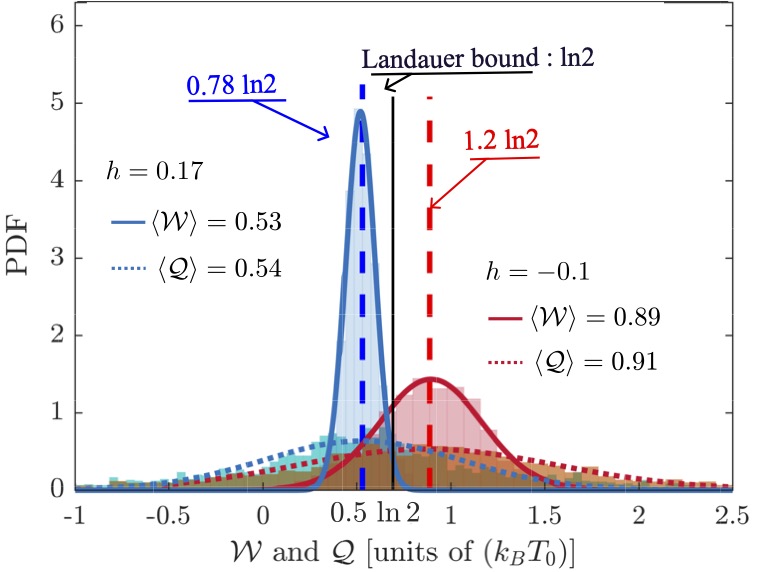
The Landauer principle establishes a fundamental lower bound on the energetic cost of erasure for a one-bit memory in thermal equilibrium. Here, we experimentally demonstrate how this bound can be shifted by introducing a hysteretic bias h in the feedback-generated virtual potential of a micro-resonator acting as the information bit. By tuning the hysteresis, we engineer a nonequilibrium steady state with an adjustable effective temperature different from the bath temperature, enabling erasure processes that consume more than 20% less energy than the Landauer bound kBT0ln 2. Unlike sub-Landauer protocols that rely on a deliberately prepared nonequilibrium initial state, the cost reduction observed here is generated during reset by an embedded feedback bias acting as an information engine. The same platform reproduces the standard quasistatic result at h=0 and shifts the asymptotic erasure cost above or below it for h≠0. Our results provide a clean experimental playground for theoretical descriptions based on feedback, information flow, hidden controller states, and generalized nonequilibrium Landauer relations.
Download article

When trajectory-based bounds fail: information thermodynamics under noisy feedback

Natalia Ruiz-Pino, Ludovic Bellon, Antonio Prados, submitted to Phys. Rev. X

arXiv: 2607.27299

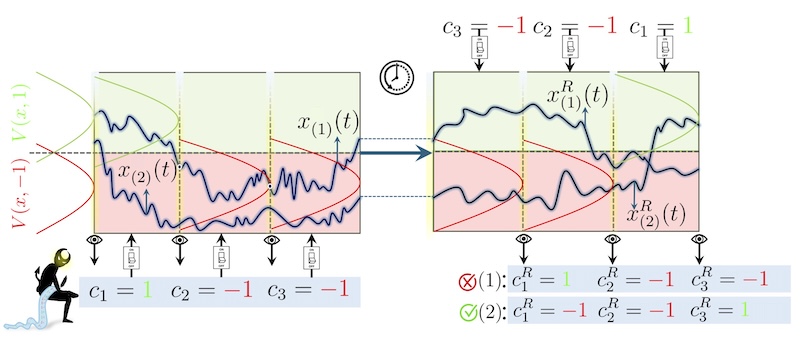
Information engines exploit feedback to extract work from thermal fluctuations, extending the second law of thermodynamics through information-theoretic bounds. While several such bounds have been proposed, their relative performance under realistic conditions — where measurements are noisy and feedback is temporally correlated — remains largely unclear. Here, we experimentally and theoretically investigate this problem in an underdamped feedback-controlled system with Markovian measurements but non-Markovian control sequences. We compare three representative bounds derived from transfer entropy, unavailable information, and Markovian mutual information, and find that none is universally optimal. Instead, measurement noise preferentially affects information measures that rely on detailed trajectory statistics, while leaving quantities based on instantaneous correlations comparatively robust. As a consequence, trajectory-dependent bounds deteriorate rapidly, giving rise to a crossover in which the Markovian mutual-information bound becomes tighter than the unavailable-information bound over a broad range of measurement noise. Our results reveal a general limitation of information-theoretic descriptions that rely on detailed trajectory statistics in realistic settings and provide a unified perspective on information thermodynamics beyond idealised feedback protocols.

Download pdf

A neural-network Maxwell’s demon learns cold damping for work extraction

Stephen Whitelam, Sergio Ciliberto, Ludovic Bellon, submitted to Phys. Rev. E

arXiv: 2607.06822

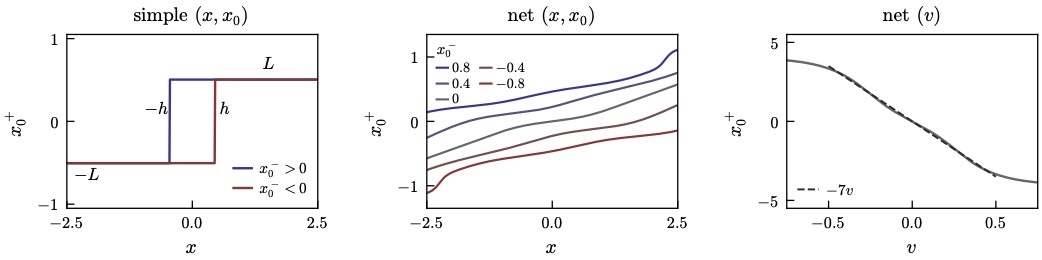
We train a neural-network Maxwell’s demon to extract work from a model of an underdamped micromechanical cantilever subject to thermal noise. The demon, which periodically adjusts the position of a harmonic trap, is trained to maximize the power extracted under steady-state operation. When the demon is given the cantilever position and trap position as inputs it learns a refined version of an existing hand-designed protocol, yielding a substantial improvement in performance. When the demon receives the oscillator velocity as input it discovers a qualitatively different strategy that extracts substantially more work, close to the theoretical power bound. Analysis of the protocol shows that it implements cold damping: the trap position is displaced approximately linearly with velocity, producing an effective increase of the oscillator’s damping coefficient and a reduction of its effective temperature. Thus a neural-network Maxwell’s demon rediscovers a well-known cooling strategy from optomechanics, revealing a simple physical mechanism underlying near-optimal work extraction from thermal fluctuations in an underdamped system.

Download pdf

First passage time for an underdamped harmonic oscillator and application to the power of an information engine

Aubin Archambault, Caroline Crauste-Thibierge, Alberto Imparato, Sergio Ciliberto, Ludovic Bellon, submitted to Phys. Rev. Lett.

arXiv: 2607.01405

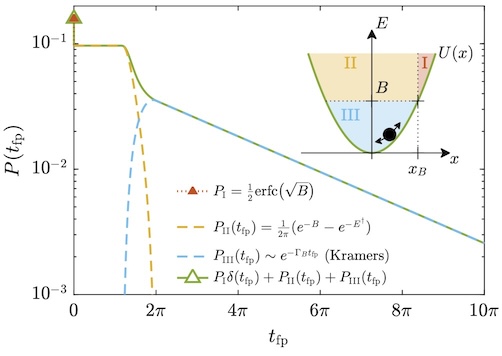
The distribution of the first passage time tfp for the position x to overcome a threshold xB is calculated in an underdamped harmonic oscillator. The proof combines several approaches based on the determination of the eigenvalues of the Kramers differential operator for the intermediate and long time regimes and on a Hamiltonian approximation for the short times. The theoretical predictions are in excellent agreement with the results of an experiment on an underdamped micro-cantilever. The knowledge of the tfp distribution opens the way to several applications, among them the precise estimation of the power of information engines, which we have also experimentally checked.

Download pdf

First passage time distribution in underdamped harmonic oscillators

Aubin Archambault, Caroline Crauste-Thibierge, Alberto Imparato, Sergio Ciliberto, Ludovic Bellon, submitted to Phys. Rev. E

arXiv: 2607.01405

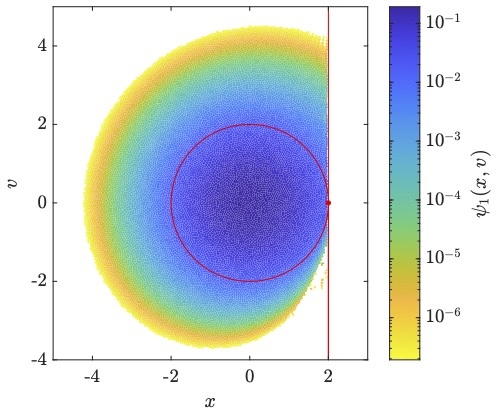
We derive the distribution of the first passage time tfp for the position x of an underdamped harmonic oscillator to overcome a threshold xB. As the tfp distribution depends on the oscillator quality factor Q different approaches are used. At very large quality factor (Q≫100) and intermediate and long tfp the proof is based on an energy diffusion model, whereas at medium quality factor (Q∼10) the proof is based on the study of the eigenvalues of the Kramers linear differential operator with absorbing boundary conditions. For all Q and short tfp we use a Hamiltonian approximation. The theoretical predictions are in excellent agreement with direct numerical simulations of underdamped oscillator dynamics. Finally we show that the mean of the trajectories ending at tfp presents a particular shape driven by a specific noise pattern.

Download pdf

Force spectroscopy on Molecular Rotors

Ludovic Bellon, Chem 12, 102690 (2026)

doi: 10.1016/j.chempr.2025.102690

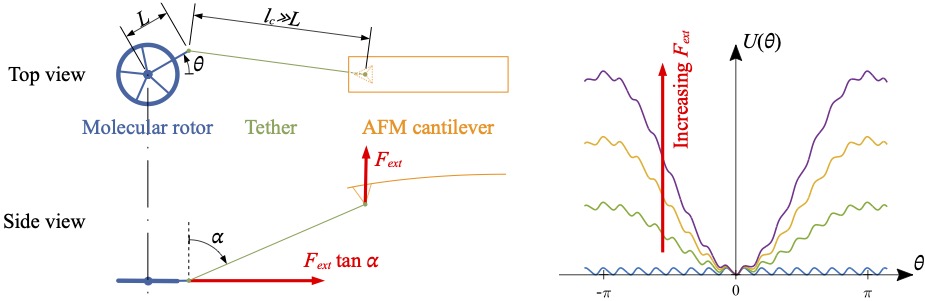
In Chem 12, 102691 (2025), Li et al.[i] describe the use of atomic force spectroscopy to detect, stall, and characterize a single molecular rotor. Their work extends force spectroscopy beyond linear deformations, offering a powerful, accessible alternative to tunneling microscopy for probing molecular rotation and associated energy landscapes

Download article
Hal record


[i] X. Li, Y. Gisbert, M. Ledent, D. Sluysmans, G. Rapenne, C. Kammerer and A.-S.  Duwez. Probing the free rotary oscillations around a single ruthenium atom in an organometallic complex. Chem 12102691 (2025)

Information engine fueled by first-passage times

Aubin Archambault, Caroline Crauste-Thibierge, Alberto Imparato, Christopher Jarzynski, Sergio Ciliberto and Ludovic Bellon, Phy. Rev. Lett. 135, 147101 (2025)

CNRS Press release: en français | in English

[article] doi: 10.1103/s9kj-lczm
[dataset] doi: 10.5281/zenodo.16928293

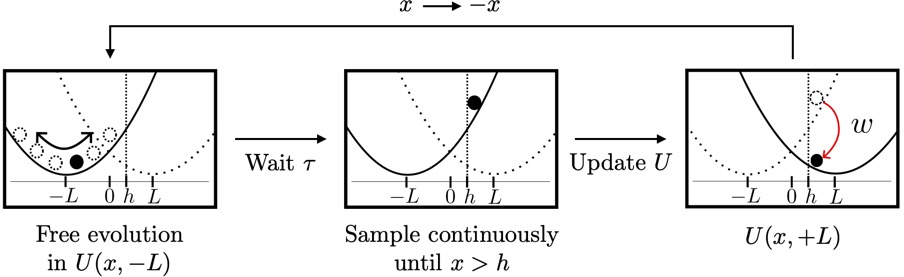
Using a mechanical cantilever submitted to electrostatic feedback control, we investigate the thermodynamic properties of an information engine that extracts work from thermal fluctuations. The cantilever position is rapidly sampled and the feedback is triggered by the first passage of the system across a fixed threshold. The information ∆I associated with the feedback is based on the first-passage-time distribution. In this setting, we derive and experimentally verify two distinct fluctuation theorems that involve ∆I and give a tight bound on the work produced by the engine. Our results extend beyond the specific application to our experiment: we develop a general framework for obtaining fluctuation theorems and work bounds, formulated in terms of probability distributions of protocols rather than underlying measurement outcomes.

Download pdf

Fluctuations at work : energetic optimizations in experimental stochastic thermodynamics

Nicolas Barros, PhD Thesis, ENS de Lyon (2025)

hal: tel-05282725

This thesis aims to understand and optimize physical processes in small systems with few degrees of freedom, where thermal fluctuations play a central role. Stochastic thermodynamics provides a suitable framework to describe such random behaviors. We present a versatile and robust experimental setup designed to investigate the laws of thermodynamics at the nanoscale, using the fluctuations of a mechanical oscillator subjected to a tunable feedback potential. The system’s precision and reliability are demonstrated throughout our study by an excellent agreement with both simulations and theoretical predictions. We tackle several fundamental questions in stochastic thermodynamics related to energy exchanges and information processing. Thanks to great statistics and efficient out-of-equilibrium protocols, we show how the second law of thermodynamics can be locally surpassed in 95% of our experiments, while still holding on average. We then apply tools from optimization theory and machine learning to perform irreversible logical operations efficiently in finite time, highlighting the benefits of this approach for broader objectives. Finally, we probe the experimental limits of our system to expand the range of operations. By independently tuning the temperature and confinement of the cantilever, we pave the way for a comprehensive study of a one-particle heat engine. Overall, this work demonstrates that while classical thermodynamic principles remain valid at small scales, fluctuating systems reveal rich behaviors and significant opportunities for energetic optimization.

Download pdf

Learning efficient erasure protocols for an underdamped memory

Nicolas Barros, Stephen Whitelam, Sergio Ciliberto and Ludovic Bellon, Phys. Rev. E 111, 044114 (2025)

[article] doi: 10.1103/PhysRevE.111.044114
[dataset] doi: 10.5281/zenodo.13829199

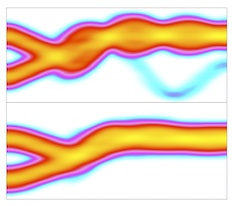
We apply evolutionary reinforcement learning to a simulation model in order to identify efficient time-dependent erasure protocols for a physical realization of a one-bit memory by an underdamped mechanical cantilever. We show that these protocols, when applied to the cantilever in the laboratory, are considerably more efficient than our best hand-designed protocols. The learned protocols allow reliable high-speed erasure by minimizing the heating of the memory during the operation. More generally, the combination of methods used here opens the door to the rational design of efficient protocols for a variety of physics applications.

Download pdf