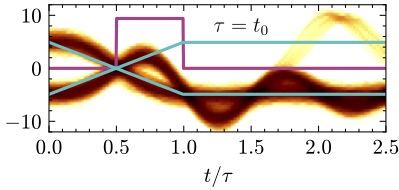
Work as a function of protocol duration for the efficient erasure of an underdamped memory: isothermal to adiabatic transition

Nicolas Barros, Stephen Whitelam, Sergio Ciliberto, Ludovic Bellon, submitted to J. Stat. Mech.

arXiv: 2609.11473

We use evolutionary reinforcement learning to determine efficient time-dependent erasure protocols for an underdamped cantilever moving in a double-well potential, an experimental realization of a 1-bit memory. We investigate how the mean work ⟨W⟩ needed to erase a bit scales as a function of the protocol duration τ. We find two regimes, depending on how τ compares to the relaxation time of the system tr. For τ≫tr, the quasistatic isothermal regime, we recover Landauer’s bound plus an overhead that scales as 1/τ, similar to the overdamped case. By contrast, for τ<tr erasure becomes adiabatic and ⟨W⟩ grows more slowly than in the isothermal case. This growth is bounded from below as 1/τ, which we derive using a gedanken optimal protocol. Finally, comparison with overdamped erasure shows that learned protocols can outperform protocols that are optimal subject to equilibrium boundary conditions.
Download pdf

When trajectory-based bounds fail: information thermodynamics under noisy feedback

Natalia Ruiz-Pino, Ludovic Bellon, Antonio Prados, submitted to Phys. Rev. X

arXiv: 2607.27299

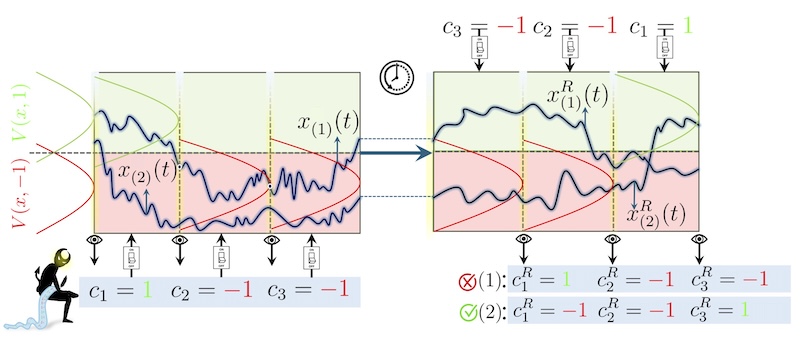
Information engines exploit feedback to extract work from thermal fluctuations, extending the second law of thermodynamics through information-theoretic bounds. While several such bounds have been proposed, their relative performance under realistic conditions — where measurements are noisy and feedback is temporally correlated — remains largely unclear. Here, we experimentally and theoretically investigate this problem in an underdamped feedback-controlled system with Markovian measurements but non-Markovian control sequences. We compare three representative bounds derived from transfer entropy, unavailable information, and Markovian mutual information, and find that none is universally optimal. Instead, measurement noise preferentially affects information measures that rely on detailed trajectory statistics, while leaving quantities based on instantaneous correlations comparatively robust. As a consequence, trajectory-dependent bounds deteriorate rapidly, giving rise to a crossover in which the Markovian mutual-information bound becomes tighter than the unavailable-information bound over a broad range of measurement noise. Our results reveal a general limitation of information-theoretic descriptions that rely on detailed trajectory statistics in realistic settings and provide a unified perspective on information thermodynamics beyond idealised feedback protocols.

Download pdf

A neural-network Maxwell’s demon learns cold damping for work extraction

Stephen Whitelam, Sergio Ciliberto, Ludovic Bellon, submitted to Phys. Rev. E

arXiv: 2607.06822

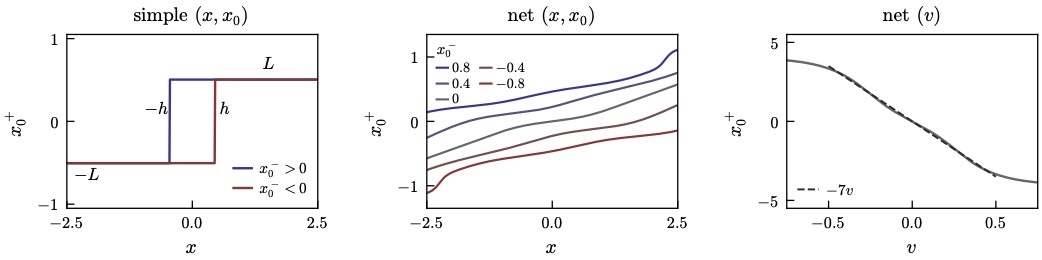
We train a neural-network Maxwell’s demon to extract work from a model of an underdamped micromechanical cantilever subject to thermal noise. The demon, which periodically adjusts the position of a harmonic trap, is trained to maximize the power extracted under steady-state operation. When the demon is given the cantilever position and trap position as inputs it learns a refined version of an existing hand-designed protocol, yielding a substantial improvement in performance. When the demon receives the oscillator velocity as input it discovers a qualitatively different strategy that extracts substantially more work, close to the theoretical power bound. Analysis of the protocol shows that it implements cold damping: the trap position is displaced approximately linearly with velocity, producing an effective increase of the oscillator’s damping coefficient and a reduction of its effective temperature. Thus a neural-network Maxwell’s demon rediscovers a well-known cooling strategy from optomechanics, revealing a simple physical mechanism underlying near-optimal work extraction from thermal fluctuations in an underdamped system.

Download pdf

First passage time distribution in underdamped harmonic oscillators

Aubin Archambault, Caroline Crauste-Thibierge, Alberto Imparato, Sergio Ciliberto, Ludovic Bellon, submitted to Phys. Rev. E

arXiv: 2607.01405

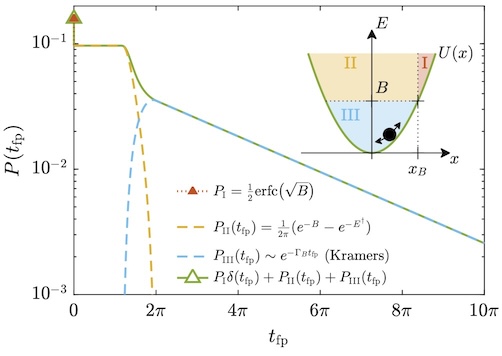
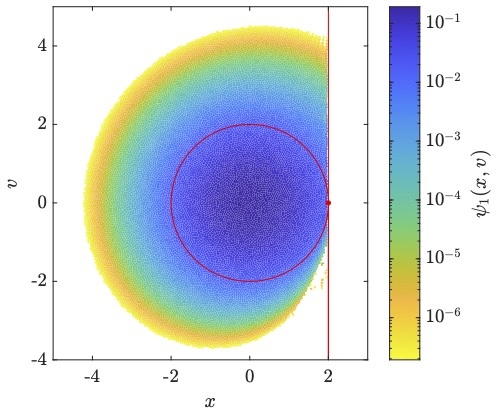
We derive the distribution of the first passage time tfp for the position x of an underdamped harmonic oscillator to overcome a threshold xB. As the tfp distribution depends on the oscillator quality factor Q different approaches are used. At very large quality factor (Q≫100) and intermediate and long tfp the proof is based on an energy diffusion model, whereas at medium quality factor (Q∼10) the proof is based on the study of the eigenvalues of the Kramers linear differential operator with absorbing boundary conditions. For all Q and short tfp we use a Hamiltonian approximation. The theoretical predictions are in excellent agreement with direct numerical simulations of underdamped oscillator dynamics. Finally we show that the mean of the trajectories ending at tfp presents a particular shape driven by a specific noise pattern.

Download pdf

First passage time for an underdamped harmonic oscillator and application to the power of an information engine

Aubin Archambault, Caroline Crauste-Thibierge, Alberto Imparato, Sergio Ciliberto, Ludovic Bellon, submitted to Phys. Rev. Lett.

arXiv: 2607.01405

The distribution of the first passage time tfp for the position x to overcome a threshold xB is calculated in an underdamped harmonic oscillator. The proof combines several approaches based on the determination of the eigenvalues of the Kramers differential operator for the intermediate and long time regimes and on a Hamiltonian approximation for the short times. The theoretical predictions are in excellent agreement with the results of an experiment on an underdamped micro-cantilever. The knowledge of the tfp distribution opens the way to several applications, among them the precise estimation of the power of information engines, which we have also experimentally checked.

Download pdf

Virtual potential created by a feedback loop: taming the feedback demon to explore stochastic thermodynamics of underdamped systems

Salambô Dago, Nicolas Barros, Jorge Pereda, Sergio Ciliberto, Ludovic Bellon
in Bouju, X., Joachim, C. (eds) Crossroad of Maxwell Demon. CMD 2023. Advances in Atom and Single Molecule Machines. Springer, Cham.

doi: 10.1007/978-3-031-57904-2_6
arXiv: 2311.12687

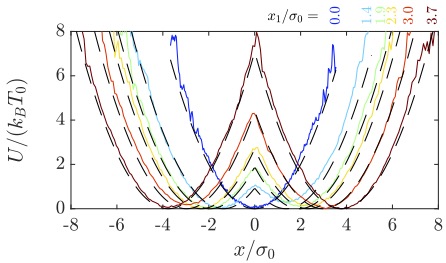
Virtual potentials are an elegant, precise and flexible tool to manipulate small systems and explore fundamental questions in stochastic thermodynamics. In particular double-well potentials have applications in information processing, such as the demonstration of Landauer’s principle. In this chapter, we detail the implementation of a feedback loop for an underdamped system, in order to build a tunable virtual double-well potential. This feedback behaves as a demon acting on the system depending on the outcome of a continuously running measurement. It can thus modify the energy exchanges with the thermostat and create an out-of-equilibrium state. To create a bi-stable potential, the feedback consists only in switching an external force between two steady values when the measured position crosses a threshold. We show that a small delay of the feedback loop in the switches between the two wells results in a modified velocity distribution. The latter can be interpreted as a cooling of the kinetic temperature of the system. Using a fast digital feedback, we successfully address all experimental issues to create a virtual potential that is statistically indistinguishable from a physical one, with a tunable barrier height and energy step between the two wells.

Download pdf