Salambô Dago and Ludovic Bellon, Phys. Rev. Lett. – Accepted 8 September, 2026
[article] doi: 10.1103/rw6w-bskc
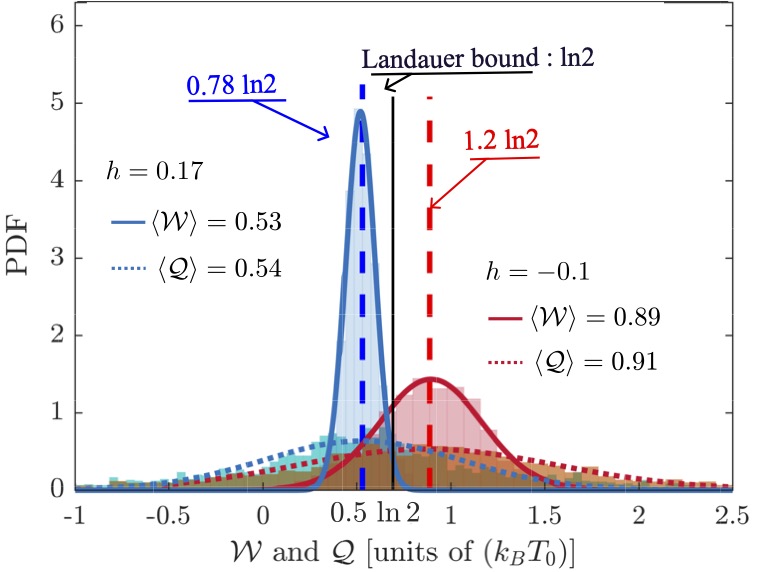
The Landauer principle establishes a fundamental lower bound on the energetic cost of erasure for a one-bit memory in thermal equilibrium. Here, we experimentally demonstrate how this bound can be shifted by introducing a hysteretic bias h in the feedback-generated virtual potential of a micro-resonator acting as the information bit. By tuning the hysteresis, we engineer a nonequilibrium steady state with an adjustable effective temperature different from the bath temperature, enabling erasure processes that consume more than 20% less energy than the Landauer bound kBT0ln 2. Unlike sub-Landauer protocols that rely on a deliberately prepared nonequilibrium initial state, the cost reduction observed here is generated during reset by an embedded feedback bias acting as an information engine. The same platform reproduces the standard quasistatic result at h=0 and shifts the asymptotic erasure cost above or below it for h≠0. Our results provide a clean experimental playground for theoretical descriptions based on feedback, information flow, hidden controller states, and generalized nonequilibrium Landauer relations.